by Amy K Grandvoinet
<3.oO×°.*x
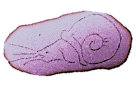
Marina Herlop is a Catalonian pianist-singer. Her album Pripyat (2022) is named after an abandoned city in northern Ukraine evacuated due to the 1986 Chernobyl Disaster. On the front-cover is the Most Beautiful Snail with a human face,
<3.oO×°.*x
In medieval marginalia many knights are doodled in snail-fights. For the snail is so strong: its home on its back, its creation of darts only loving. 2015, or thereabouts, a lady dressed as a snail for a renters’ demonstration. It made the Cambridge {not-the-Cambrian} News. Her papier-mâché shell read: I WANT A HOME. To not want to beat snails, but to be as snails. Peaceful, slow, & ever-housed,
<3.oO×°.*x
Human-beings, o shell-less vertebrates. Shelter my species’ requisit, its acquisition a complex endeavour. You spend years moving about, Baby, in precari manner only somewhat now-muted Karl Marx’s Capital I (1867) quotes Sophocles it says ‘Money — u demolish cities, root men from their homes’. Making shells help! of sofas, of vacant beds, strangers, Café Csiga in Budapest. Fantasy Abode that is not private property, neither threatened by war nuclear nor {nor!} otherwhisse,
<3.oO×°.*x
[Non-Lyrical vocals]. In The Lost Lunar Baedeker (1997) Mina Loy, a William Blake 4 the age electronic, speaks on love speaks on sex the tome’s wrapped in another snail-human imago title gosh! ‘Fallen Angel’ oil-paint’d 1992 into sandpaper. Hybrîd arching neck looking up @ y sky; eyes chin nose heavenward in earth-ish pearlescence, anthropo-faccia very sérene. Within, a tract reads ‘For to what end is our experience of life if deprived of a fitting aesthetic revelation in our faces?’ Pobl looking més like pobl when depicted as snailles i.e. dod o trouble-free dwellings,
<3.oO×°.*x
How at home I am with snails sings Frank O’Hara in ‘A Proud Poem’ (1951),
<3.oO×°.*x
Is poetry a slime of us snails? Sitting outside Gwesty Cymru, we ask ‘In fifty years time will the snails all have faces?’ Taking rubbish out next am morning he finds countless snails {yes mostly in pairs} grinding sweetly. ‘Jerusalem’ (1808) praising snails’ valiant desire-spears & citing God’s hope that all people be prophets (Numbers, 11:29). ‘Fable XXIV’ (1727) gives another bonica snail real faceful {yes!}
Philip Hoare’s comment:
This is brilliantly clever and adventurous piece of writing that knows no bounds. It is picaresque and funny – love the inclusion of Mina Loy & Blake, two great genre-defying artists from the past. The writing is unique and yet falls into a tradition of experimentation – I think of the Dadaists, and post-punks.
The word-play is luxuriant and sparky and glorious freeform and surreal, and it matches the Bjork-like spirit of its subject, a Catalan original. I want to hear the writer sing or recite or perform this piece: it speaks with such a strong individual voice.
 Philip Hoare Competition